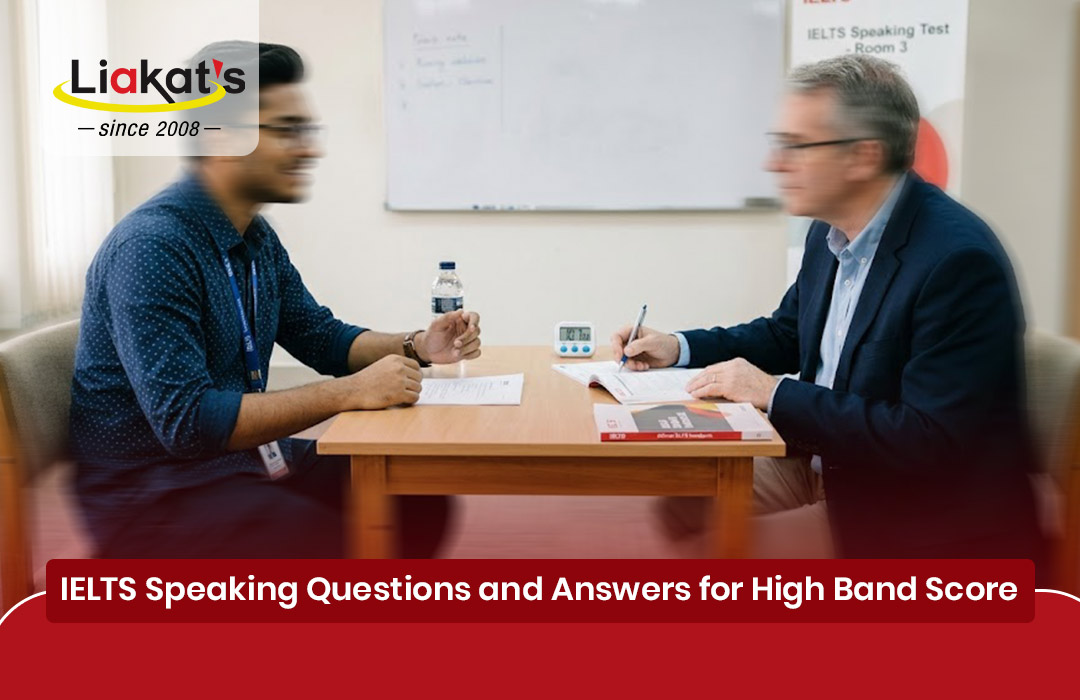
Overview of IELTS Speaking Test Structure and Duration
The IELTS speaking test is conducted as a face-to-face interview. The total duration is usually between 11 and 14 minutes. It is divided into three parts, and each part is designed to test different speaking skills.
The use of structured IELTS Speaking Questions and Answers is strongly recommended during preparation. As a result, confidence and fluency can be improved significantly.
IELTS Speaking Test Parts:
- Part 1: Introduction and familiar questions
- Part 2: Cue card topic (long answer)
- Part 3: Discussion and opinion questions
Each section must be practiced separately to ensure balanced performance.
Types of Questions Asked in IELTS Speaking Part 1
Part 1 includes simple questions about daily life. These questions are usually easy but require clear pronunciation and natural responses.
Common Part 1 Question Topics:
- Hometown
- Education
- Work or Study
- Hobbies
- Daily Routine
- Favorite Food
- Free Time Activities
Sample IELTS Speaking Questions and Answers:
Question: Where do you live?
Answer: I live in Dhaka, which is a busy city in Bangladesh. It is known for its culture and fast-paced lifestyle.
Question: What do you do in your free time?
Answer: In my free time, I usually read books and watch English videos to improve my speaking skills.
Short and natural answers should always be given.
Common IELTS Speaking Part 2 Cue Card Topics with Sample Answers
Part 2 requires speaking continuously for 1–2 minutes about a specific topic.
Common Cue Card Topics:
- Describe your favorite place
- Describe a memorable journey
- Describe a person who inspires you
- Describe your favorite book
- Describe a useful website
Sample Cue Card Answer:
Topic: Describe your favorite place
Answer:
My favorite place is Cox’s Bazar, which is the longest sea beach in the world. It is loved because of its natural beauty and peaceful environment. I visited this place last year with my family. During the trip, many photos were taken, and delicious seafood was enjoyed. I would love to visit this place again in the future.
Answers should be structured clearly with introduction, details, and conclusion.
IELTS Speaking Part 3 Discussion Questions and Answer Techniques
Part 3 includes deeper discussion questions related to Part 2 topics. Longer answers are expected.
Common Part 3 Question Types:
- Opinion Questions
- Comparison Questions
- Future Prediction Questions
- Problem-Solution Questions
Answer Techniques:
- Explain your opinion clearly
- Provide examples
- Use linking words
- Expand answers logically
Logical answers are usually rewarded with higher scores.
Band 7+ Speaking Answer Samples for Real Practice
Practicing Band 7+ IELTS Speaking Questions and Answers helps students understand the expected quality.
Sample Band 7+ Answer:
Question: Why is learning English important today?
Answer:
Learning English is considered essential today because it is widely used for international communication. Many educational and career opportunities are provided to individuals who can speak English fluently. Moreover, global knowledge can be accessed easily when English is understood.
Complex vocabulary and longer sentences should be practiced gradually.
How to Structure Your Answers for Maximum Score
Proper structure plays a major role in IELTS speaking success.
Recommended Speaking Structure:
- Start with a direct answer
- Add supporting details
- Give an example
- End with a short conclusion
When this structure is followed, answers become clearer and more impressive.
Vocabulary and Phrases to Impress the Examiner
Strong vocabulary is highly valued during the IELTS speaking test.
Useful IELTS Speaking Phrases:
- In my opinion
- From my perspective
- One of the main reasons
- It is widely believed
- As far as I know
Using advanced vocabulary should be practiced carefully to avoid mistakes.
Common Speaking Mistakes That Lower Your Band Score
Many candidates lose marks due to simple mistakes.
Common Speaking Mistakes:
- Speaking too fast
- Using memorized answers
- Incorrect grammar
- Poor pronunciation
- Lack of vocabulary
These mistakes should be corrected during practice sessions.
Tips to Improve Fluency and Pronunciation for IELTS
Fluency and pronunciation are important scoring factors.
Fluency Improvement Tips:
- Speak English daily
- Record your voice
- Practice with friends
- Listen to native speakers
Pronunciation Tips:
- Focus on word stress
- Learn correct sounds
- Practice difficult words
- Watch English videos regularly
Improvement is noticed when consistent practice is maintained.
Daily Practice Plan to Boost IELTS Speaking Confidence
Daily practice ensures steady progress.
Daily Speaking Practice Plan:
Morning:
Practice Part 1 questions for 15 minutes
Afternoon:
Practice one cue card topic
Evening:
Record Part 3 answers
Night:
Review vocabulary and mistakes
Regular practice helps confidence grow naturally.
Good vs Poor Speaking Performance
| Factor | Good Speaking | Poor Speaking |
| Fluency | Smooth and natural | Frequent pauses |
| Vocabulary | Advanced words | Basic words only |
| Pronunciation | Clear | Difficult to understand |
| Grammar | Mostly correct | Many mistakes |
How to Practice IELTS Speaking Questions and Answers
Follow this structured plan:
Step 1: Learn speaking test format
Step 2: Collect common speaking topics
Step 3: Practice daily answers
Step 4: Record and review your voice
Step 5: Improve weak areas
Step 6: Take mock speaking tests
Step 7: Repeat practice regularly
Consistent effort produces better results.
Frequently Asked Questions
1. What are IELTS Speaking Questions and Answers?
They are practice questions used to prepare for real IELTS speaking topics and improve speaking confidence.
2. How long is the IELTS speaking test?
The IELTS speaking test usually lasts 11 to 14 minutes.
3. How can I improve my IELTS speaking score quickly?
Daily speaking practice, vocabulary learning, and mock tests can improve scores faster.
4. Is memorizing answers good for IELTS speaking?
No, memorized answers are often detected and may reduce your band score.
5. How many questions are asked in IELTS Speaking Part 1?
Usually 4–6 questions are asked about familiar topics.
6. Can I practice speaking IELTS at home?
Yes, speaking practice can be done at home using sample questions and recordings.
Conclusion
Practicing IELTS Speaking Questions and Answers regularly is one of the most effective ways to achieve a high band score. When structured answers, advanced vocabulary, and daily speaking habits are combined, speaking performance improves significantly.
If you want guided speaking practice and expert feedback, consider enrolling in a professional IELTS speaking course at Liakat’s English. Start practicing today and move closer to your target IELTS band score.