Trying to understand your IELTS Academic Reading score can feel confusing at first. You finish the test with a raw score, like 28 out of 40, but your result comes back as a band score, like 6.5. How does one number turn into the other?
This guide breaks down the IELTS Academic Reading score chart in plain language. You will learn how raw scores convert to band scores, what each band from 5 to 9 actually means, and how to use this information to set a realistic study target. By the end, you will know exactly where your current reading score sits and what it takes to move up a band.
What You’ll Learn
- How the IELTS Academic Reading score is calculated
- The IELTS reading score chart from Band 4 to Band 9
- What each band score means in real terms
- Examples of Band 5, 6, 7, 8, and 9 readers
- Common mistakes that hold Bangladeshi test takers back
- A simple action plan to raise your reading band
How the IELTS Academic Reading Score Is Calculated
The IELTS Academic Reading test has 40 questions. Each correct answer earns one mark. There is no penalty for wrong answers, so it is always worth attempting every question.
Your raw score, the total number of correct answers out of 40, is then converted into a band score between 1 and 9. This conversion is done using a scale created by IELTS, which is jointly owned and administered by the British Council, IDP IELTS Australia, and Cambridge Assessment English. The Academic and General Training Reading tests use slightly different conversion tables, because the Academic test is generally considered more demanding.
One important point: the exact raw-score cutoff for each band can shift slightly from one test to another. This keeps the difficulty level fair across different test versions. The chart below reflects the typical, widely used conversion pattern for Academic Reading.
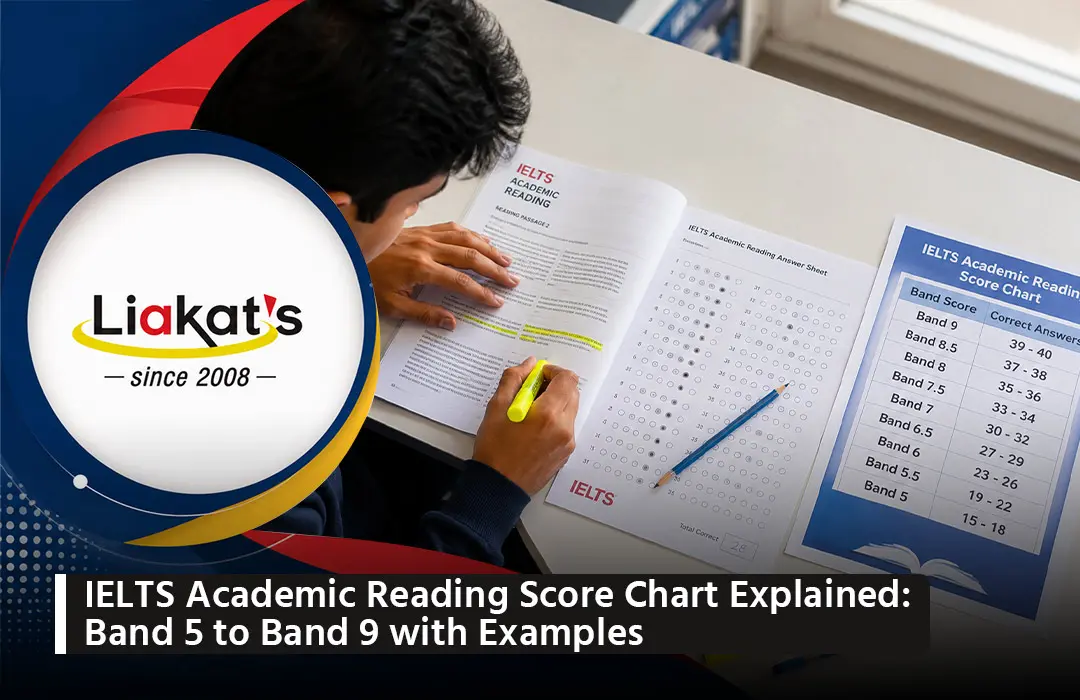
IELTS Academic Reading Score Chart (Band 4 to Band 9)
| Band Score | Raw Score (out of 40) | General Level |
| 9.0 | 39–40 | Expert user |
| 8.5 | 37–38 | Very good user |
| 8.0 | 35–36 | Very good user |
| 7.5 | 33–34 | Good user |
| 7.0 | 30–32 | Good user |
| 6.5 | 27–29 | Competent user |
| 6.0 | 23–26 | Competent user |
| 5.5 | 19–22 | Modest user |
| 5.0 | 15–18 | Modest user |
| 4.5 | 13–14 | Limited user |
| 4.0 | 10–12 | Limited user |
Two things stand out when you look at this table closely. First, the gap between bands gets wider at the lower end and narrower at the higher end. Moving from Band 5 to Band 6 might only need three or four more correct answers. Moving from Band 8 to Band 9, however, needs near-perfect accuracy.
Second, missing just one or two questions near a boundary can change your band score. This is why careful time management matters as much as vocabulary and grammar.
Academic Reading Score vs General Training Score
Many students preparing for university admission ask why their friend, who took General Training, scored higher with fewer correct answers. The answer is simple: the two tests use different conversion tables.
Academic Reading passages are longer, denser, and often taken from journals, textbooks, or research-based articles. General Training passages relate to everyday, workplace, and general interest topics. Because Academic passages are harder to process quickly, the same band score usually requires fewer correct answers than General Training.
If you are unsure which version applies to you, our IELTS Academic vs General guide, aligned with British Council guidance, explains the difference and helps you confirm the right test for your goals.
What Each Band Score Actually Means
Numbers alone do not tell the full story. Here is what each band level looks like in a real reading test.
Band 5: Modest User
A Band 5 reader can understand the general meaning of a passage and locate specific facts when they are stated clearly. Difficulty appears with paraphrased information, complex sentence structures, and questions that require inference.
Example: A Band 5 candidate correctly answers factual and matching questions but struggles with True/False/Not Given items, because they cannot always tell the difference between information that is false and information that is simply not mentioned.
Band 6: Competent User
Band 6 readers manage most passage types reasonably well. They can follow the main argument of an academic text and answer a good mix of question types correctly, though speed under time pressure is still a challenge.
Example: A Band 6 candidate finishes all three passages but rushes through the last one, missing questions that needed careful re-reading of a paraphrased sentence.
Band 7: Good User
At Band 7, readers handle unfamiliar vocabulary using context clues and understand both explicit and implied meaning. They can distinguish between the writer’s opinion and factual claims, a skill many university-bound students in Bangladesh need to strengthen.
Example: A Band 7 candidate correctly identifies the writer’s stance in an opinion-based passage and answers Yes/No/Not Given questions with confidence.
Band 8: Very Good User
Band 8 readers process complex academic texts quickly and accurately. Occasional errors happen only with unfamiliar or highly technical topics, and even then, the overall understanding stays strong.
Example: A Band 8 candidate answers nearly every question correctly across all three passages, with just one or two mistakes on detail-heavy matching questions.
Band 9: Expert User
A Band 9 reader understands academic English with the same ease as a highly educated native speaker. Complex arguments, subtle tone, and dense vocabulary present no real barrier.
Example: A Band 9 candidate answers 39 or 40 questions correctly, showing near-flawless accuracy across every question type in the test.
Why the Reading Section Trips Up So Many Bangladeshi Students
Based on common patterns we see among students preparing in Dhaka, three issues repeat again and again.
Time pressure. Sixty minutes for three passages and 40 questions leaves little room for re-reading. Many students spend too long on Passage 1 and rush Passage 3, which is usually the hardest.
Skimming and scanning weakness. Reading word by word, instead of scanning for keywords and skimming for structure, wastes valuable minutes.
True/False/Not Given confusion. This question type asks candidates to judge whether a statement matches the passage, contradicts it, or is simply absent. Many test takers guess instead of checking the text carefully, which costs marks that are otherwise easy to secure.
How to Improve Your IELTS Academic Reading Band Score
Raising your reading score is a matter of strategy as much as vocabulary. Here is a practical approach.
- Take a diagnostic test first. Know your current raw score before you start studying. Our IELTS overall score calculator helps you see how your reading result fits into your total band.
- Practice under real time limits. Always time yourself at 60 minutes, including transferring answers, so exam-day pressure feels familiar.
- Build topic-specific vocabulary. Academic passages often cover science, history, and social topics. Regular IELTS vocabulary practice makes unfamiliar words less intimidating.
- Master each question type separately. Matching headings, True/False/Not Given, and multiple choice each need a different reading approach. Our IELTS Reading practice tests are organised by question type for focused practice.
- Review your mistakes, not just your score. Understanding why an answer was wrong matters more than knowing how many you missed.
- Follow a structured plan. A reading plan built for IELTS success keeps your preparation consistent instead of random.
A Simple 4-Week Reading Improvement Plan
| Week | Focus | Goal |
| Week 1 | Diagnostic test + question type review | Identify weak question types |
| Week 2 | Skimming, scanning, and timing drills | Improve speed without losing accuracy |
| Week 3 | Full-length practice tests, timed | Build exam stamina |
| Week 4 | Error review and targeted vocabulary | Close remaining gaps |
Pair this with our IELTS band score requirements page if you are preparing for a specific university or immigration cut-off, so you know exactly which band you need across all four skills.
Frequently Asked Questions
What is a good IELTS Academic Reading score?
For most university admissions, Band 6.0 to 6.5 is considered a solid, acceptable score. Competitive programs often ask for Band 7.0 or higher.
How many correct answers do I need for Band 7 in Academic Reading? Typically 30 to 32 correct answers out of 40, though the exact cutoff can vary slightly between test versions.
Is IELTS Academic Reading harder than General Training?
Most candidates find Academic Reading more demanding because the passages are longer and more complex, which is why its conversion table requires fewer correct answers for the same band.
Can I get Band 9 in Reading without native-level English?
Yes, though it requires near-perfect accuracy and very strong command of complex academic vocabulary and structure. It is achievable with consistent, targeted practice.
Does reading speed matter more than vocabulary?
Both matter, but many students lose marks to poor time management rather than vocabulary gaps. Practicing under timed conditions is essential.
How is the reading score different from the overall IELTS band score?
Reading is one of four skills (Listening, Reading, Writing, Speaking). Your overall band score is the average of all four, rounded to the nearest half or whole band.
Where can I check the official band descriptors?
You can review the official band descriptors on the IELTS website, which is jointly managed by the British Council, IDP IELTS Australia, and Cambridge Assessment English, or see our simplified IELTS band score descriptors guide.
Track Your Progress and Keep Improving
Your IELTS Academic Reading score is not fixed. It responds directly to focused, consistent practice. Start by identifying your current band using the chart above, then work through question types systematically rather than taking random practice tests.
If you want structured guidance, explore our IELTS preparation course or book a free assessment with one of our instructors in Dhaka. We will help you set a realistic band target and build a study plan to reach it.