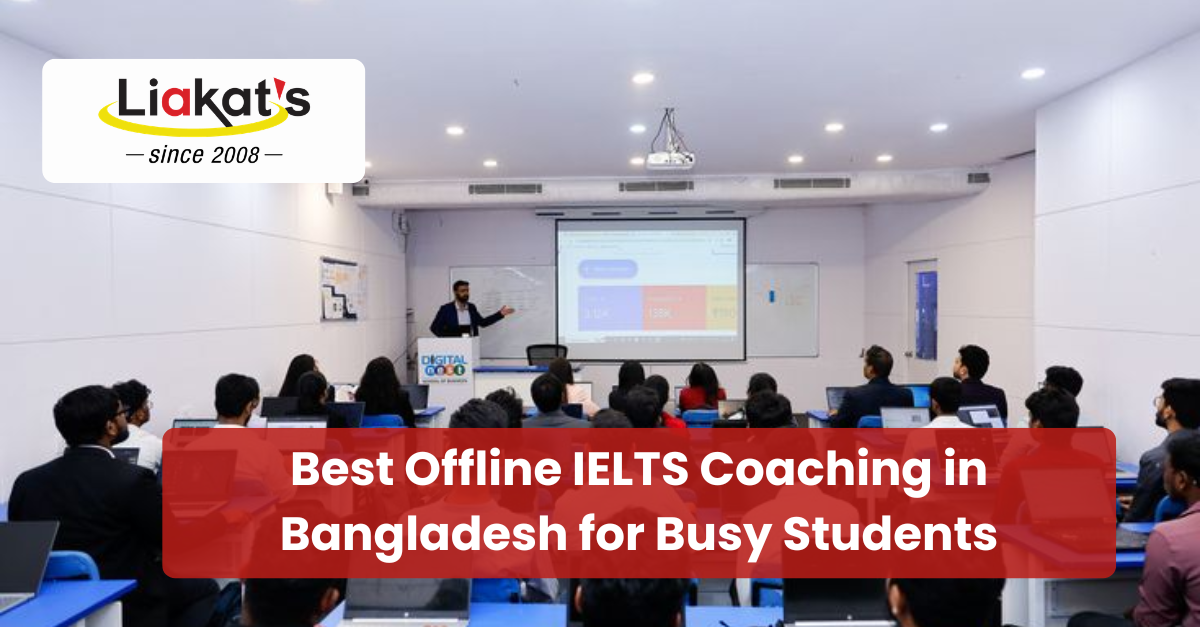
If you’re working a job, attending university, or managing a family — and you’re also trying to prepare for IELTS — you already know the problem. Most offline IELTS coaching centers in Bangladesh run their main batches at 10am or 2pm. Times that simply don’t exist in your schedule.
But the right offline coaching center for busy students does exist. You just have to know what to look for. And even if you only have 1 to 2 hours free each day, you can still prepare effectively — if your plan is realistic.
This guide covers both: how to find the right offline coaching center and how to manage your preparation time when life isn’t slowing down for IELTS.
What Busy Students Get Wrong About IELTS Preparation
Let’s not sugarcoat it. If you’re busy, your IELTS preparation will take longer. Someone studying 4 hours a day will progress faster than someone studying 2 hours. That’s just reality.
But longer doesn’t mean impossible. Thousands of working professionals and full-time students in Bangladesh have passed IELTS with strong scores while managing everything else. The difference between those who succeeded and those who didn’t usually came down to one thing: a realistic plan they actually stuck to.
Before looking for a coaching center, check our easy IELTS preparation tips for beginners to understand which daily habits matter most — even when time is tight.
What to Look for in Offline IELTS Coaching as a Busy Student
Evening and weekend batches
This is the first filter. Call before you visit. Ask specifically whether they have 7pm to 9pm weekday batches or Friday and Saturday options. Many centers offer these but don’t advertise them prominently. If they only run morning batches, that center isn’t for you.
Small batch sizes
When you’re busy, you can’t sit in a class of 40 students and not get individual feedback on your Writing or Speaking. Ask the exact current batch size — not the maximum the room can hold. Ten to twenty students is the sweet spot.
Recorded sessions or catch-up options
Life will happen. You’ll miss a class at some point. Ask whether sessions are recorded or whether there’s a way to catch up without falling behind. Centers that don’t offer this leave busy students stranded.
Short intensive courses
If your exam is 6 to 8 weeks away, a short intensive program may fit you better than a 3-month course. These usually run 4 to 6 weeks with more concentrated sessions. Just know they work best for students who already have a decent English base.
Individual feedback on Writing and Speaking
This is non-negotiable. If a center doesn’t give personal feedback on essays and speaking — don’t enroll. These are the two sections where individual feedback moves your score the most.
Where to Find Good Offline IELTS Coaching in Bangladesh
In Dhaka, the most accessible areas are Dhanmondi, Mirpur, Mohammadpur, Uttara, Gulshan, and Banani. Most established centers here offer evening options for working professionals — ask specifically.
Outside Dhaka, Chittagong has solid options around GEC Circle and Agrabad. Sylhet, Rajshahi, and Khulna have fewer choices. If offline coaching in your area isn’t practical, our online spoken English course in Bangladesh is accessible from anywhere and works well for building the speaking fluency IELTS demands.
A Realistic Weekly Study Plan for Busy Students
Here’s a practical schedule for someone with 1.5 to 2 hours available on weekdays and more time on weekends.
Monday to Friday — Morning (20 to 30 minutes)
Start with vocabulary. Learn 5 to 8 new words, use each one in a sentence, and review yesterday’s words quickly. This small daily habit adds up to hundreds of new words in a month. Our English vocabulary practice tips give you a simple, time-efficient system for exactly this.
Monday to Friday — Evening (60 to 90 minutes)
Attend your coaching class if scheduled. If not, use this block for focused self-study — timed Reading one day, Listening the next, Writing the day after. Don’t try to cover everything in one sitting.
Before bed (10 to 15 minutes)
Put on an English podcast, a news clip, or an IELTS listening audio. Just listen — no pressure, no notes. Our free English listening resources for students have great options specifically designed for this kind of short, daily passive practice.
Saturday (3 to 4 hours)
This is your main study block for the week. First half: do one full timed practice section. Second half: write one complete Writing Task 2 essay under timed conditions. Before sending it to your teacher, check it using a grammar checking tool to catch basic errors on your own first.
Sunday (30 to 45 minutes)
Rest. Burnout is a real risk for busy students. Keep Sunday light — a short vocabulary review or some English content is enough. Heavy cramming on rest days slows down long-term progress.
Step-by-Step: 8-Week Plan for Busy Students
Week 1 and 2 — Take a full practice test. Join your coaching center. Focus on understanding all four IELTS sections, the format, and how each one is marked.
Week 3 and 4 — Focus your self-study on your two weakest sections. Practice daily. Attend every coaching session.
Week 5 and 6 — Write two timed essays per week. Keep up daily listening. One full timed Reading or Listening test every Saturday.
Week 7 — Sit for a complete full-length mock exam on Saturday. Review every answer on Sunday. List what still needs work.
Week 8 — Light strategy review. Focus on your strongest sections to build confidence. No heavy cramming in the last 3 days before the exam.
For a more detailed version of this plan, our IELTS study plan to achieve Band 7 gives you a full week-by-week roadmap built around limited study time.
Final Thought
Being busy doesn’t disqualify you from IELTS. It just means you need a smarter plan than someone who studies full time. Find a coaching center that works around your life, not the other way around. Build small daily habits. Protect your main weekly study day. And never skip feedback on Writing and Speaking.
For more IELTS guides and resources, visit liakats.com. And if you want to build spoken English confidence alongside your offline coaching, our spoken English course in Bangladesh is flexible enough to fit around any schedule.