What Is the IELTS Exam?
The IELTS exam, also known as the International English Language Testing System, is widely accepted for education, work, and migration purposes. Many universities and employers require IELTS scores before applications are approved.
For beginners, understanding the IELTS test format explained for beginners is considered the first step toward success. The exam is designed to measure English language skills in real-life situations.
Why IELTS Is Important:
- Required for studying abroad
- Accepted by universities worldwide
- Needed for immigration purposes
- Improves English communication skills
- Increases global job opportunities
Therefore, a clear understanding of the IELTS format should always be gained before starting preparation.
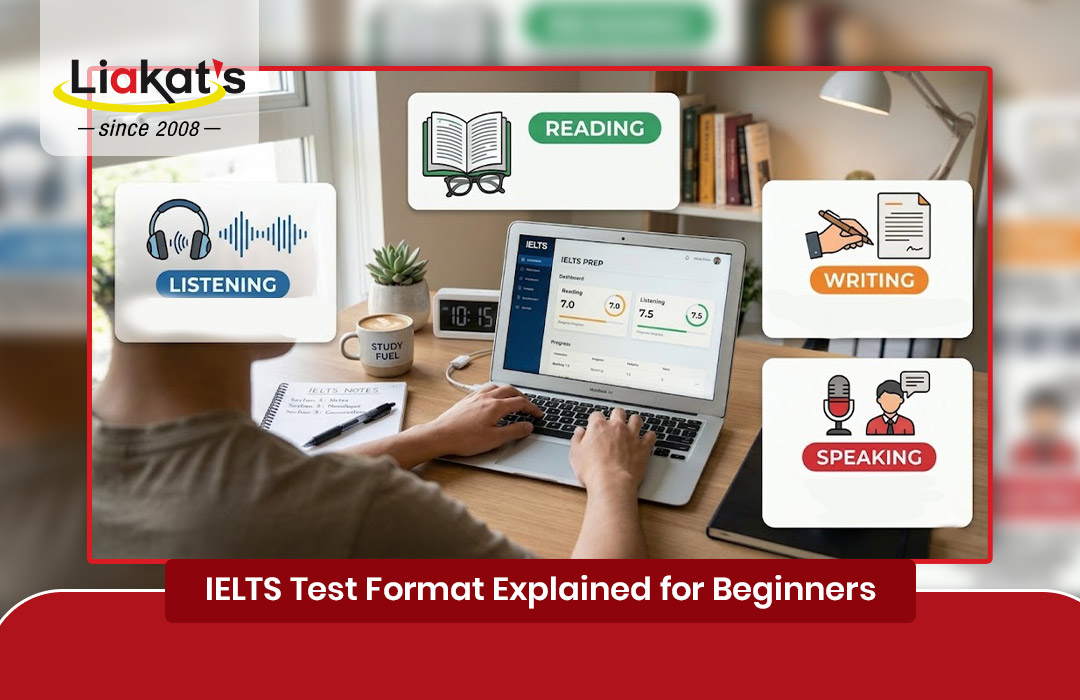
IELTS Test Sections Overview: Listening, Reading, Writing, Speaking
The IELTS exam includes four major sections. Each section is designed to test a different skill.
| Section | Duration | Skills Tested |
| Listening | 30 Minutes | Listening Ability |
| Reading | 60 Minutes | Reading Skills |
| Writing | 60 Minutes | Writing Skills |
| Speaking | 11–14 Minutes | Speaking Skills |
Each section is equally important, and balanced preparation should be followed.
Detailed IELTS Listening Format with Question Types
The Listening section includes four recorded audio parts. Candidates are required to listen carefully and answer questions.
Common Listening Question Types:
- Multiple choice questions
- Matching information
- Map labeling
- Sentence completion
- Form completion
Usually, recordings are played only once. Therefore, concentration is highly recommended during listening practice.
IELTS Reading Format: Academic vs General Differences
The Reading section varies depending on the chosen test type.
| Feature | Academic Reading | General Reading |
| Text Type | Academic Articles | Daily Use Text |
| Difficulty Level | Higher | Moderate |
| Number of Passages | 3 Passages | 3 Sections |
| Reading Purpose | Study | Work & Migration |
Understanding these differences helps beginners prepare more efficiently.
IELTS Writing Task 1 and Task 2 Explained Simply
The Writing section contains two tasks, and both tasks must be completed within 60 minutes.
Writing Task Overview:
Task 1:
- Academic: Describe graphs or charts
- General: Write a formal or informal letter
Task 2:
- Write an essay based on a given topic
- Provide opinions and arguments
- Use proper grammar and structure
It is recommended that writing practice should be done daily to improve performance.
IELTS Speaking Test Format and Evaluation Criteria
The Speaking test is conducted as a face-to-face interview. It usually lasts 11 to 14 minutes.
Speaking Test Parts:
- Introduction and interview
- Cue card speaking
- Discussion session
Evaluation Criteria:
- Fluency and coherence
- Vocabulary usage
- Grammar accuracy
- Pronunciation clarity
These factors are considered while scoring speaking performance.
IELTS Band Score System Explained (0–9 Scale)
IELTS scores range from Band 0 to Band 9. Each band represents a level of English proficiency.
| Band Score | Skill Level |
| Band 9 | Expert User |
| Band 7–8 | Good User |
| Band 6 | Competent User |
| Band 5 | Modest User |
| Band 4 | Limited User |
Most universities require a Band 6.0 to Band 7.5 score.
Computer-Based vs Paper-Based IELTS: Key Differences
Two IELTS test formats are available. Candidates can select based on their comfort level.
| Feature | Computer-Based | Paper-Based |
| Writing Mode | Typing | Handwriting |
| Result Time | Faster | Slower |
| Availability | Frequent | Limited |
| Convenience | Flexible | Traditional |
Computer-based tests are increasingly preferred due to faster results.
Time Management Tips for Each IELTS Section
Proper time management plays an important role in achieving a high band score.
Time Management Tips:
- Read instructions carefully
- Divide time evenly
- Avoid spending too long on one question
- Practice mock tests regularly
- Review answers before submission
Effective time management increases accuracy and confidence.
Step-by-Step Guide: IELTS Test Format Explained for Beginners
Follow this step-by-step process to understand IELTS format easily:
Step 1: Learn the structure of all four sections
Step 2: Understand question types
Step 3: Practice with sample tests
Step 4: Identify weak areas
Step 5: Improve grammar and vocabulary
Step 6: Take full mock exams
Step 7: Review mistakes regularly
This systematic approach helps beginners feel more confident before the actual exam.
Frequently Asked Questions
1. How long is the IELTS exam?
The IELTS exam lasts 2 hours and 45 minutes, including all four sections.
2. Which IELTS section is the most difficult?
The Writing section is often considered the most challenging due to grammar and time pressure.
3. Can beginners understand the IELTS format easily?
Yes, beginners can understand the IELTS format with proper guidance and regular practice.
4. How many questions are in the IELTS Listening section?
There are 40 questions in the Listening section.
5. Is computer-based IELTS easier than paper-based?
Both formats are equal in difficulty, but computer-based tests provide faster results.
6. What band score is required for beginners?
Most beginners aim for Band 6.0 or higher depending on their study goals.
Conclusion
Understanding the IELTS Test Format Explained for Beginners is considered one of the most important steps before starting IELTS preparation. Each section of the IELTS exam follows a structured format, and proper practice should be maintained regularly.
If you want to achieve a high band score, structured learning and expert guidance should be considered. Visit Liakats English today to explore professional IELTS preparation courses and start your journey toward success.